




Machinery and Electrical Equipment Manufacture
Wuhan Building Materials Industry Design & Research Institute Co., Ltd, established in 1965, is a wholly-owned subsidiary of Sinoma Energy Conservation Ltd. which belongs to CNBM Group. Possessing Class A design qualification in the building materials industry, specializing in machinery and electrical equipment manufacture, mainly focusing on high capacity fiber cement production line, press machine with oil-treatment system, flow-on sheet forming machine, some related equipment.
Why Choose Us
R&d And Innovation Capacity
The company has a strong R & D and innovation capacity of equipment, with more than 60 patents and software copyrights, and has been certified as a national high-tech enterprise.
Technical Staff
There are 400 employees, including 16 professor-level senior engineers, 70 senior engineers, 90 mid-level and above engineers, and 310 other professional and technical personnel.
Rich Experience
Our company has been deeply engaged in the Calcium Silicate board / Fiber Cement board industry for more than 40 years, so far, it has cooperated with many largegroup companies such as SHERA, Saint-Gobain, ASK, VEFA, Etex, Conch Cement, etc., and has cooperated in more than 200 production lines in the world.
Reasonable Price
We only use the highest quality building materials and have a product to meet any budget and to meet any specification for any project.


Types of Machinery and Electrical Equipment Manufacture
The Machinery and Electrical Equipment Manufacture Produced by Our Company Mainly Include the Following Types:
High Capacity Fiber Cement Production Line
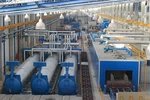
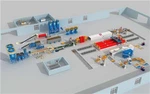
The high capacity fiber cement production line integrates various advanced technologies and equipment to continuously process raw materials into fiber cement products.
Press Machine With Oil-treatment System
A press machine with oil-treatment system, or also known as a forming press, is a tool used in the manufacturing industry to deform a workpiece under high pressure.
Flow-on Sheet Forming Machine
Flow-on Sheet Forming Machine carries out a highly efficient process that takes long metal coils and fabricates them into exact configurations and end products.
Stacking Machine
A palletizer is an automated equipment that is mainly used to stack products packed into containers, such as bags, cartons or boxes, on pallets or pallets in a certain arrangement for automatic stacking.
Hatschek Sheet Forming Machine
The Hatschek Sheet Forming Machine is a specialized piece of equipment used to produce fiber cement boards, especially fireproof boards. Its rugged construction and precision engineering ensure long-term stable operation, providing high-quality sheets and minimizing the need for repair or replacement.
Destacker and Sorting System
The destacker and sorting system significantly improves the efficiency of plate processing through automation. Compared with traditional manual operations, this system can continuously and stably perform plate depalletizing and sorting operations without interruption.
High Capacity Fiber Cement Production Line Basic Parameters
The basic parameters mainly refer to the following table:
|
Item |
Unit |
Fiber cement flat board |
|
Density |
g/cm3 |
1.35 |
|
Flexural Strength |
MPa |
>9 |
|
Heat Conductivity |
w/m.k |
<0.29 |
|
Impact Strength |
kJ/mm2 |
>0.2 |
Press Machine with Oil-treatment System Parameter
|
Products Parameter |
5000T |
7500T |
10000T |
|
Nominal pressure(KN) |
50000 |
75000 |
100000 |
|
System pressure(Mpa) |
27 |
40 |
53.5 |
|
Bed dimension(mm) |
1280*3200 |
1280*3200 |
1280*3200 |
|
Max opening height (mm) |
1680/1100 |
1680/1100 |
1680/1100 |
|
Max piston rod travel |
450 |
450 |
450 |
|
Motor power(KW) |
15 |
22 |
22 |

Advantages of Stacking Machine
Better Unitized Loads
Stacking machine is a method of unitizing loads for shipment. Unitized loads (which are groups of items that you can handle as one unit instead of separately) are less likely to shift during transportation than individual products, which results in less damage.
Reduced Labor Costs
A stacking machine will do all the work for you. These machines require minimal human intervention. They automatically handle every step of the palletizing process.
Decreased Likelihood of Damage
Stacking machine sort, transfer, and stack your products the same way every time. This means fewer mistakes and, consequently, more stable loads.
Increased Productivity
Stacking machines can boost the productivity of your warehouse or distribution center dramatically. This means you can produce more in less time and with fewer errors.
Application of Stacking Machine
Food and Beverage Industry
Ideal for high-volume production lines where products like canned goods or bottles are uniform in size and shape.
Manufacturing of Consumer Goods
Suitable for places producing large quantities of identical items, such as household products.
Building Materials
Effective for stacking uniform items like bricks or tiles, where speed is crucial.
E-commerce and Retail
Offers the ability to handle a wide variety of product types and sizes. Best for businesses with diverse inventories.
Pharmaceuticals
Suitable for factories that need precise handling and flexibility due to changing package sizes and the delicate nature of products.
Custom Packaging Operations
Great for businesses that need to quickly adapt to changing packaging needs or product designs.
How to Choose Stacking Machine
It Fits Your Specific Needs
First and foremost, you'll want to understand what you need in a stacking machine in terms of design, automation and technology.
Rate of Palletization
The rate of palletization refers to how quickly loads are able to be formed. Each stacking machine can be measured by how quickly it can in-feed pallets based on the packaging and handling requirements of your products.
Adaptability for Different Products Being Palletized
It is also possible that your packaging and palletizing needs will change over time. This means you will want to consider how well your stacking machine can adapt to new requirements via programming and handling capabilities.
Palletizing Environment
Stacking machines can be designed in many different ways, some requiring more operating space than others.
Load Removal Process
How palletized loads are removed from the palletizing cell is crucial to the end of line process. Consider an ideal workflow when comparing stacking machine design options.
Evaluate Integration with Existing Systems
Finally, consider how the new stacking machine will integrate with your existing equipment and systems. Check whether the stacking machine can communicate with your current conveyor systems, packing machines, or production software.
Advantages of Flow-on Sheet Forming Machine
High Production Efficiency: The flow-on sheet forming machine adopts a continuous production method to transform raw materials into finished products through a series of orderly processing steps.
Stable Product Quality: During the production process of the flow-on sheet forming machine, the flow-on sheet forming machine ensures the stability and consistency of product quality by precisely controlling key links such as heating and melting, mold forming, and cooling and solidification.
High Degree Of Automation: Flow-on sheet forming machines are usually equipped with advanced automation control systems, realizing fully automated production from raw material transportation to finished product winding.
Low Raw Material Loss: In terms of raw material loss, a flow-on sheet forming machine also has certain advantages. This is mainly due to its precise control system and efficient processing process.
Our Certificate


Video